
Phaethon — The Borrowed Sun
A myth of fathers, proof, reckless tenderness, and the terrible cost of being believed too late.

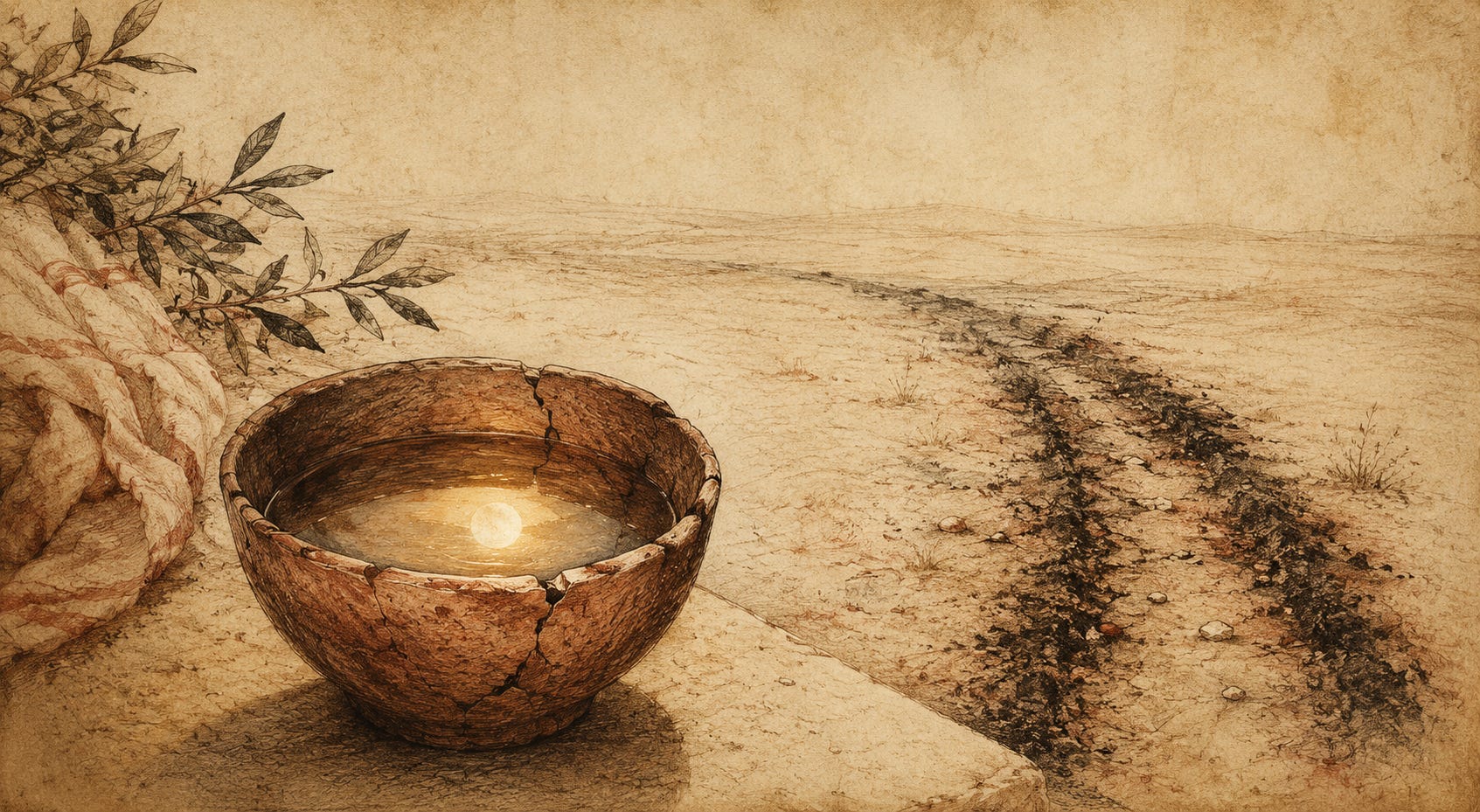
The first thing Phaethon saw that morning was the sun inside a cup.
It was not much of a cup. Clay, brown at the rim, cracked along one side and mended by someone with more patience than skill. It stood on the low table outside his mother’s house, where the morning came down white and warm over the courtyard stones. A little water remained in it from the night before, and in that water the sun had set a trembling disc of itself.
Phaethon leaned over it.
There it was: bright, round, impossible to touch, and small enough, for one brief moment, to be held by a child’s two hands.
He was still looking at it when the other boy laughed.
There were three of them in the courtyard that morning, though only one mattered afterward. The others were boys from nearby houses, boys who came and went as boys do, carrying figs, sticks, rumours, bruises, and the particular cruelty that belongs to children before anyone has taught them its proper name. They had been playing at races with bits of reed for horses, dragging lines through the dust and arguing over whose chariot had won. Phaethon had won twice, which was perhaps the beginning of the trouble. It is often dangerous to win in front of someone who had hoped not to lose.
“You only say that,” said the other boy, “because your father is supposed to be the Sun.”
Phaethon turned.
No one had said the word supposed before.
The boy saw what it had done and came nearer. Children are quick in that way. They hear the floor give beneath another child’s foot and know at once where to step.
“My father says no god leaves a son in a little house with his mother,” he said. “My father says men tell women all kinds of things, and women tell boys all kinds of things after that.”
The courtyard went still.
The cup on the table held the sun without trembling now.
Phaethon struck him, of course. There are boys who can hear their mother mocked and answer with philosophy, but they are either very rare or very untruthful in the stories told about them. Phaethon struck him in the mouth. The other boy struck back. The reeds were crushed underfoot. Someone shouted. Someone ran to fetch the mothers. By the time Clymene came out from the house, Phaethon was standing with dust on his knees and blood under one nostril, breathing hard, trying not to cry from fury rather than pain.
The other boy had begun to cry openly by then, which was one of the privileges of having started the trouble and lost it.
“What happened?” Clymene asked.
No one answered.
Then Phaethon said, “He said you lied.”
There are questions a mother can answer easily. Have you eaten? Where is your cloak? Who broke the handle from the jar? There are other questions that can be answered truthfully and still not answered enough.
Clymene looked at her son.
She was not a queen, though some later tellers made her one, perhaps because they could not bear the thought of such a grief beginning in a plain house with cracked cups. She was beautiful, yes, but beauty is not a rank. She had known a god, and that is a thing which makes a woman important in songs and lonely in life. She had raised the boy under ordinary roofs. She had washed him, fed him, rebuked him, sung him to sleep, watched his height come upon him too quickly, and seen in his face, sometimes, a light that frightened her because it was not wholly hers.
She came close and wiped the blood from his lip with her thumb.
“I did not lie.”
He stared at her.
“Then make him know it.”
“That is not always given to us.”
“Then make me know it.”
That was the truer wound. Not the insult. Not even the shame before the others. Phaethon had believed her all his life, but belief is a lamp, and there are rooms where the wind gets in. One sentence from a jealous boy had made the lamp flutter.
Clymene sent the other boys away. She brought Phaethon inside and washed the dust from his face. He stood rigid while she did it, no longer a child enough to be comforted by the touch, not yet grown enough to refuse it. The house smelled of olive oil, linen, old smoke, and the bread she had lifted from the hearth before it burned. Outside, a goat complained at its tether. The world, which had been ordinary an hour before, continued to behave as though nothing had happened.
“My son,” Clymene said, “your father is Helios. He sees the earth from morning to evening. He sees kings at their tables and shepherds among stones. He sees ships at sea, graves in fields, thieves at doors, children waking, women drawing water, men lifting their hands to him when they have no other witness. He saw me. He loved me. You were born from that love.”
Phaethon listened. He had heard this before, in softer forms, when he was little and wanted the story because it made him feel chosen. Now the same words entered him differently. They had become something to be tested.
“Then why does he not come?”
Clymene looked toward the doorway, where light stood on the floor.
“Gods do not keep houses as we do.”
“That is what people say when gods are not there.”
She could have rebuked him for that.
She did not.
Instead she said, “If my word is not enough, go to him.”
Phaethon blinked.
“Go east,” she said. “Go beyond the lands you know. Ask the Hours, if they will answer you. Ask at the gates of morning. If he is your father, he will not deny you.”
There was courage in telling him that. There was also fear. Parents often do not know which of the two they are using until too late.
Phaethon looked once more at the cup outside the door before he left. The sun in it had broken into pieces where dust had settled on the water. He took nothing from the house except his cloak, a little bread wrapped in cloth, and the injury inside him, which weighed more than both.
He went east.
For some days, the world remained the world he knew. Olive trees gave way to dry fields. Dry fields gave way to hills. The villages grew fewer. Dogs barked at him and old women asked where he was going. He answered badly at first, then learned not to answer. At night he slept beside low fires or under walls, and each morning the sun rose ahead of him as if it knew he was coming and wished to keep its distance.
After a time, the road changed.
The air grew thin and bright. Stones shone even in shadow. The birds were fewer. The east was no longer a direction but a presence. Everything seemed to be waiting for morning before morning had fully come. The colours there were too clear. The grass was edged with light. Even the dust looked awake.
At last he came to the gates.
They were not gates in the way a house has gates. No hinge could have held them. No carpenter could have made them. They stood at the edge of the world where night, having done its work, loosened its hand from the earth. Around them moved the Hours, grave and beautiful, with fingers stained by light. They were harnessing brightness to the morning.
Phaethon stopped.
He had imagined many things on the road. He had imagined a hall, a throne, a father rising in wonder. He had imagined himself speaking boldly. He had imagined returning home with proof so complete that the other boy would never again know where to put his eyes.
He had not imagined how small he would feel.
One of the Hours looked at him.
“Why has a child come so far?”
“I am not a child,” said Phaethon, which proved almost nothing.
The Hour’s face did not change.
“I am Phaethon, son of Clymene,” he said. “I have come to speak with Helios.”
The Hours turned toward one another. It was a very small movement, but Phaethon felt the air alter.
“Many speak to the Sun,” said the Hour. “Few ask to be answered.”
“I ask to be answered.”
The gates opened.
The palace of the Sun was not a place built for description. Too much brightness defeats the tongue. There was light there with weight. Fire that did not burn but simply was. Walls that seemed made of dawn held still for a moment before release.
At the centre of it stood Helios.
He was not merely bright. Brightness was what he gave to smaller things. He was the power by which colour returned each morning to the world, by which frost loosened from grass, by which sailors knew direction, by which seeds woke in the dark soil and lifted their green ignorance toward the air. His hair shone as if each strand remembered the first day. His eyes had looked upon everything under heaven and still, when they fell on Phaethon, something in them changed.
“My son,” he said.
The words struck Phaethon harder than the other boy’s insult had done.
My son.
There it was. The thing he had come for. The answer. The proof. Spoken not by a mother defending her own story, but by the god himself in the house of morning. It should have been enough.
It almost was.
Helios came down from his high place and took Phaethon by the shoulders. The god’s hands were warm, but not burning. This surprised the boy and nearly undid him. He had expected splendour. He had not expected gentleness.
“You have come far,” Helios said.
“I had to.”
“Who told you so?”
Phaethon looked away.
“No one.”
The Sun, who saw thieves at doors and kings in their lies, knew perfectly well when a boy was not telling the whole truth. But fatherhood, even divine fatherhood, can make intelligence clumsy.
“Someone wounded you,” Helios said.
Phaethon said nothing.
“Then let the wound be answered. Ask what you will. By the river that binds the gods, I swear I will grant it.”
The Hours went still.
There are moments in a tale when every older thing in the world seems to lean forward, not because it does not know what will happen, but because it knows too well. The oath had been spoken. A god may be careless with tenderness, but he cannot be careless with Styx. The promise passed out of Helios’s mouth and became law.
Phaethon felt it.
He felt the splendour of it, the terror, the sudden rising power of being able to ask. He should have asked for a sign. A token. A crown of light. A word sent back to his mother’s house. He should have asked his father to stand before the boys who had mocked him. He should have asked for almost anything else.
But shame is greedy. It does not want enough. It wants the thing that no one can question.
“Let me drive your chariot for one day.”
Helios did not move.
“No.”
The answer came so quickly that Phaethon stepped back.
“You swore.”
“I swore before I knew what you would ask.”
“You swore by Styx.”
“Yes,” said Helios, and for the first time he sounded less like the Sun than like any father who has spoken too quickly in love and heard the door close behind his words.
Phaethon’s face hardened.
“You said I was your son.”
“You are.”
“Then let me be seen as your son.”
Helios looked toward the gates, where the horses had begun to stamp.
They were not horses such as men keep in stables, though later painters have done their best with them. Their names were fire, breath, thunder, glare. Their manes lifted like wind at the edge of flame. Their hooves struck sparks from a floor no mortal quarry had given stone to make. They knew the road of the sky, but they knew it because Helios held them. They did not love reins. They endured them.
“No god asks this,” Helios said. “Do you understand? No god. Not Zeus, who rules. Not Poseidon, who shakes the deep. Not even Athena, whose mind is sharper than a spearhead. The road climbs too steeply at first, and then drops where the earth pulls. There are places where the sky thins. There are places where the cold will enter your bones and places where the heat will rise up to meet you. The horses know my hand. They know my weight. They know my voice. They will not know yours.”
“Then teach me.”
“There is no teaching for this.”
“Because you do not want me to have it.”
Helios bent then, bringing his face nearer to the boy’s.
His light lowered with him. The whole hall seemed to dim in obedience, not much, but enough for Phaethon to see the grief already forming in his father’s eyes.
“Because I want you to live.”
That should have entered him.
It did enter him, but not where it could help. Phaethon heard love and mistrusted it because it was shaped like refusal. He had come all that way to escape doubt, and now doubt put on his father’s face and told him no.
“You promised,” he said.
Helios closed his eyes.
When he opened them, morning had come nearer. The world below waited in darkness, as it always did before his rising. Men and women slept with no thought of the boy standing beside the chariot. Flowers remained folded. Ships lay unseen on the black water. Wolves nosed the edge of pens. Mothers turned in their beds and reached toward children who were still there.
The day had to begin.
Helios placed his hand on Phaethon’s head. It was both blessing and farewell, though the boy did not yet know enough to feel the difference.
“Hold the middle path,” he said. “Not too high, or heaven itself will burn you. Not too low, or earth will burn beneath you. Do not pull against them in panic. Do not slacken the reins in wonder. Above all, do not look down too long.”
Phaethon nodded.
He heard very little beyond the fact that his father had yielded.
The Hours brought the chariot forward.
Light gathered around its wheels. Dawn bent itself into harness. The eastern gate widened. For one instant Phaethon looked magnificent. That must be admitted. He stood where no mortal child had stood, his hair filled with the first fire of the morning, his hands on the reins of the day. If any of the boys from his mother’s courtyard could have seen him then, they would have been silent for the rest of their lives.
The horses surged.
The chariot leapt.
At first, Phaethon laughed.
How could he not? The world opened beneath him in one enormous breath. Night fled westward like a cloak drawn back from a sleeping face. Mountains rose out of darkness. Rivers caught fire. The sea flashed and rolled. Cities appeared small enough to cover with a thumb. Birds scattered below him, startled from trees by a dawn too sudden and too wild. He was no longer the boy in the courtyard. He was not the son whose mother had to be believed. He was proof, burning across the sky.
Then the horses understood.
The hand on the reins was wrong.
Not weak, exactly. The boy pulled hard enough. But he pulled without knowledge. He did not know the road through the air. He did not know where morning grew heavy, where the season turned beneath the wheels, where the cold gathered, where the earth rose up invisibly toward the course of day. He had been given brightness. He had not been given rule.
The horses climbed.
Too high.
The earth fell away until even Phaethon feared its smallness. The cold struck him. The reins stiffened in his hands. His breath tore from him in white gasps. He pulled down.
The horses plunged.
Too low.
The tops of mountains smoked. Forests, which had stood in their own green patience for longer than any boy can imagine, darkened and sparked. Springs shrank back into stone. Rivers showed their beds like old scars. In fields, men looked up and cried out, though they did not know to whom. Women gathered children under roofs that could not protect them. Animals ran with no understanding except that the world above had become hostile.
Phaethon pulled one way. The horses tore another.
He shouted his father’s words. They were good words. They had no force in his mouth.
That was the terror. Not only fire. Not only height. Not only the world beginning to suffer beneath him. The terror was that the day itself had been placed into hands that did not know how to hold it.
His palms burned on reins he could not release. His mouth filled with smoke. The brightness he had borrowed no longer proved anything except his smallness. Somewhere inside the roar he began to understand—not fully, for full understanding belongs to those who survive long enough to be ashamed—but enough. His father had not refused him because he was unloved. His father had refused him because love sees the height of the fall before the child has reached the edge.
“Father!” he cried.
Helios heard him.
Of course he heard him.
He had heard shepherds singing in the cold before dawn. He had heard queens weep where no attendant could see. He had heard the first cry of every child born under morning. He heard Phaethon cry out from the broken road of the sky, and all his light could not reach him in time.
The earth burned hotter.
The heavens shuddered.
Then Zeus rose.
There are gods whose mercy looks gentle because they arrive early. Zeus was not one of them. He came when the world could bear no more. In his hand was the thunderbolt, not as decoration, not as threat, but as decision.
Helios cried out against him.
That, too, must be remembered. The father cried out. He knew what had to happen and cried out against it anyway, because knowledge does not always make obedience clean.
The thunderbolt fell.
For a moment there was more light than day.
Then the chariot was empty.
The horses broke loose, wild with terror, until other hands seized them in the upper air. The wheel, freed from its true road, spun once through smoke and vanished. Across the sky, the path of fire tore and faded. The world below did not know at first that it had been saved. It only knew that the burning had stopped.
Far away, in a country Phaethon had never seen, something fell into a river.
The river took him because rivers take what the sky cannot keep.
By evening, the earth had begun to cool. Smoke stood in low places. Birds returned badly, bewildered by the changed shapes of trees. People came out from under roofs and looked at fields they would have to learn again. They spoke of fire. They spoke of wrath. They spoke of omens, gods, punishment, and the strange road that had burned across the pale ground.
In his mother’s courtyard, the cracked cup still stood on the low table.
No one had moved it.
The water inside had dried. Around the inner curve, where the sun had rested that morning in a trembling disc, there was a ring of dust and light-coloured clay. Clymene stood beside it for a long time after the messengers came, though what messenger can truly bring such news? A boy had gone east. The sky had burned. A body had fallen. A father had been the Sun and still had not saved him.
She touched the cup with one finger.
It broke at the old crack.
That was all.
No great sound.
No sign from heaven.
Only the small failure of something already damaged, giving way at last.
In some dry places, after summer has done its worst, people still point to a dark line running over the pale earth where no cart has passed. They give reasons for it: fire, drought, a trick of stone. They may be right.
Still, step over it carefully.
Some roads are not made for returning.