

What makes Niobe difficult is not that grief enters the story.
The old myths are full of grief. They know how quickly a household can be changed. They know that the human world is made of fragile things: children, cups, names, garments, sleep, thresholds, hands.
What makes Niobe difficult is that grief is given no cure.
There is no descent and return, as there is with Persephone. No backward glance, as there is with Orpheus. No faithful house visited by disguised gods, as there is with Philemon and Baucis. No final restoration, however strange or incomplete. Niobe does not go down into darkness and come back bearing knowledge. She does not receive mercy in the form of reunion. She does not learn wisdom and resume her place among the living.
She remains.
That is the unbearable force of the myth.
Niobe is often remembered as a warning against pride. This is not wrong, but it is not enough. She boasts against Leto, mother of Apollo and Artemis. She measures motherhood by abundance and imagines that what can be counted can also be used as proof. In that sense, the tale belongs to one of the oldest Greek patterns: the mortal who forgets the difference between human fortune and divine order.
But if Niobe were only a pride tale, it would be smaller than it is.
The deepest pressure of the story arrives after the boast, after the divine response, after the house has been emptied. The myth does not end with punishment. It continues into aftermath. It asks what becomes of a mother when the life by which she knew herself has been taken beyond recall.
This is where metamorphosis matters.
In Greek myth, transformation is rarely decoration. It is not simply magic happening to a body. It is often a form of truth arriving too late for ordinary life. A person becomes tree, bird, flower, echo, spring, constellation, stone. The change does not erase what came before. It preserves it under another law.
Daphne becomes laurel, but flight remains inside the leaves. Arachne becomes a spider, but the labour of weaving remains. Philomela becomes a nightingale, but the wound of speech remains transformed into song.
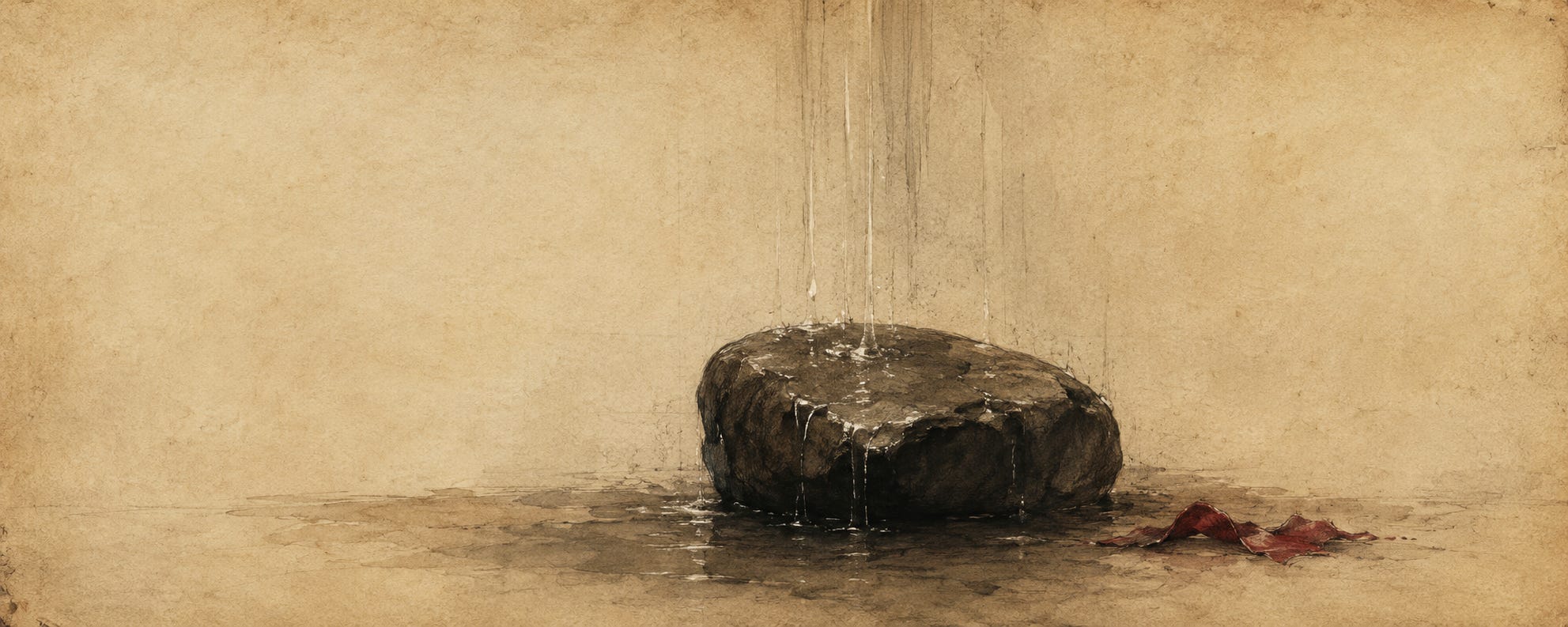
Niobe becomes stone.
That does not mean she stops grieving.
It means grief has found the only form left to it.
Stone can easily be misunderstood here. We often speak of someone becoming “stony” when we mean cold, numb, hard, unfeeling. That is not Niobe. Her stone is not emotional absence. It is not indifference. It is not the hardening of a heart that no longer cares.
The old story insists otherwise.
The stone weeps.
That image changes everything. It prevents the transformation from becoming simple punishment, simple numbness, or simple end. Niobe’s body becomes stone, but the water continues. Feeling has not disappeared. It has outlived speech, movement, and ordinary human response.
That is why the myth is so severe.
Niobe’s grief does not become useful. It does not teach the city a tidy lesson. It does not make her morally better in any comforting way. It does not redeem the divine violence that produced it. It remains what grief often is in life: excessive, wordless, repetitive, impossible to distribute fairly, impossible to finish.
The human body is built for continuation. That is one of its cruellest mercies. Even in grief, it asks for water, sleep, food, shelter. It rises. It answers when spoken to. It learns the new geography of rooms. It discovers what must be moved, what cannot yet be touched, what name cannot be spoken aloud.
Niobe’s myth imagines a grief beyond even that.
Her transformation is not a cure for sorrow. It is the collapse of the body’s ordinary offices under sorrow’s weight. The hands need no longer hold. The mouth need no longer answer. The feet need no longer cross the rooms where absence has become permanent. The face need no longer plead its case before the living.
But the grief remains.
It runs over the stone.
This is why the tale should not be reduced to the question of whether Niobe deserved what happened. That question belongs to the machinery of punishment, and punishment is not where the myth’s deepest attention finally rests. The more enduring question is stranger and more human:
What form can grief take when the human form can no longer bear it?
Greek myth often answers such questions through visible change. It does not always argue. It shows. A girl becomes a tree. A voice becomes an echo. A weaver becomes a spider. A mother becomes a stone beneath falling water.
We may want the myth to declare itself more clearly: to condemn the gods, absolve Niobe, soften the loss, or convert the ending into mercy. But the story does not move that way. It is older and colder than repair.
Yet it is not without tenderness.
The tenderness lies in witness.
The myth does not allow Niobe to vanish. It does not let her grief become private and then disappear from memory. It gives sorrow a place in the world. The stone remains where others can come upon it. The water continues where others can hear it. The mother is no longer reachable, but she is not erased.
That is a small mercy, and a terrible one.
A gentler story might have given Niobe comfort. A harsher story might have left only ruin. This story gives her form. It does not make grief beautiful in order to excuse it. It makes grief visible because some losses, if they cannot be healed, must at least not be denied.
That may be why Niobe endures.
Not because she is an example of pride punished, though she is that too. Not because the gods are justified, or unjustified, or merely cruel, though the tale leaves those pressures burning in the background. She endures because the image is exact.
A mother stands after language has failed.
The body cannot continue being human.
The stone is quiet.
Still, it is wet.