

What makes Actaeon’s story so difficult is that he does not arrive as a villain.
He does not storm the clearing. He does not set out to profane the goddess. He does not boast, challenge, seize, or blaspheme. He is hunting, as he has hunted before. He follows the track. He leaves the company of men. He hears water. He enters a place he does not yet know how to read.
Then he sees.
That is almost all he does.
And in the old story, almost is enough.
The myth comes to us most famously through Ovid’s Metamorphoses. Actaeon, a young hunter, comes by accident upon Diana — Artemis to the Greeks — as she bathes with her attendants in a hidden valley. The goddess, deprived of her bow, takes water in her hands and throws it over him. He is changed into a stag. He runs. His own hounds, unable to recognise the master they love, pursue him.
It is a brutal tale, but not a simple one.
Modern readers often want the old myths to arrange themselves into moral answers. Was Actaeon guilty? Was Artemis cruel? Was the punishment disproportionate? These questions matter. The myth does not make them vanish. But it does not answer them as a verdict, or as a clean hierarchy of blame, because it belongs to a world where the sacred does not always wait for intention to explain itself.
Actaeon’s eye crosses the boundary before Actaeon knows there is a boundary to cross.
The clearing is not neutral ground. It is not simply a pretty place where a goddess happens to be. It is an interior: a room made of laurel, water, shade, and divine privacy. Actaeon has no map for that kind of room. He is a hunter. The forest has always offered itself to him as ground to be crossed, read, tracked, entered, and mastered. He knows paths, hoofmarks, wind, dogs, water, pursuit. He knows how to move through the green world as though movement itself were permission.
Then he comes to a place where movement is not permission.
This is why Artemis matters.
She should not be reduced to embarrassment, prudery, or rage. Nor does the myth require us to call her just in any comfortable human sense. Artemis is one of the old powers of boundary: wildness, chastity, distance, animal life, the hunt, the young before marriage, the places outside the city and beyond ordinary human governance. Her privacy is not merely personal. It is part of the order by which she is divine.
To see her wrongly is therefore not only to see a body.
It is to enter what has not been offered.
That does not make the punishment easy. It should not be easy. The force of Actaeon’s myth depends upon the terrible gap between accident and consequence. He may not mean harm. He may lower his eyes too late. He may understand, in the instant after seeing, that he has done something no apology can gather back. But the sight has already entered him.
What the eye has taken cannot simply be given back.
This is where the myth remains unsettled, and must remain so.
If Actaeon were a predator, the story would be easier. If Artemis were merely vindictive, the story would also be easier. But the myth denies us both comforts. It gives us a mortal who may be more careless than corrupt, and a goddess whose answer is exact, ancient, and unbearable. It does not ask us to approve. It asks us to stand inside a world where some thresholds punish the crossing before the trespasser has learned their names.
The transformation into a stag is not arbitrary. It is the myth’s terrible precision.
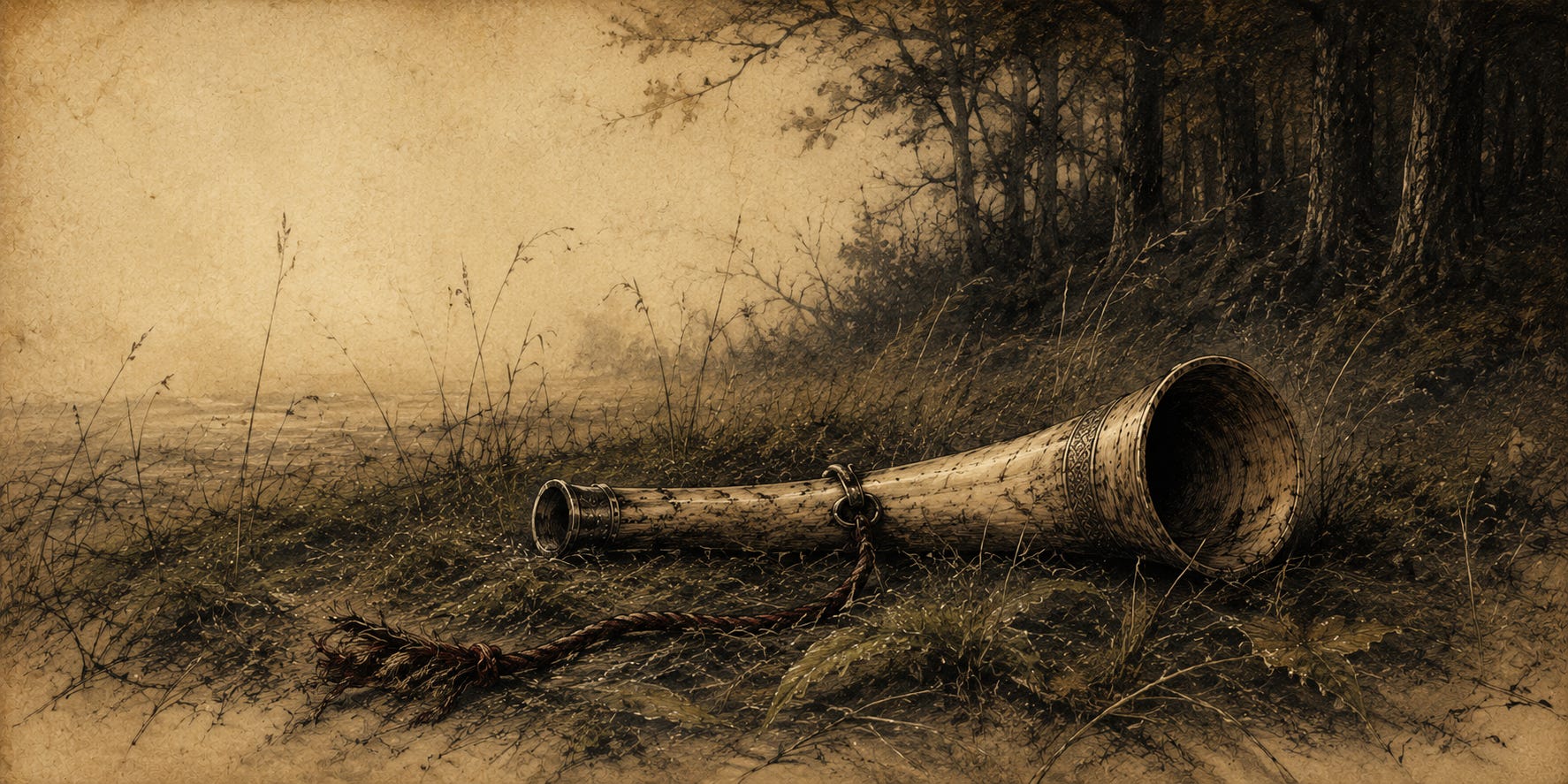
Actaeon enters as a hunter: reader of tracks, commander of dogs, man of horn and strap and open ground. Artemis does not simply erase him. She returns him into the logic he has been using all morning. The hunter becomes visible as hunted. The one who looked becomes the one looked at. The one who followed signs becomes the sign every hound can read.
His punishment is not only to suffer.
It is to be made legible in the wrong form.
This is why the dogs are essential.
Without them, Actaeon’s story would be a tale of divine punishment and bodily change. With them, it becomes a tragedy of recognition. The hounds do not become evil. They do not betray him. They are not monstrous instruments of cruelty. They remain exactly what he has made them: disciplined, eager, responsive, beautifully trained. Their failure is not malice. It is fidelity carried into disaster.
They cannot know the stag is Actaeon because the world no longer gives them Actaeon in a form they can read.
That is the wound beneath the wound.
He knows himself.
They do not.
In many myths of metamorphosis, transformation reveals a hidden truth. Pride may become a creature of endless making. Grief may root itself into bark. Flight may become river, flower, bird, or stone. The new form says something about the old life. But Actaeon’s transformation is cruel in another way: it divides consciousness from appearance. Inside the stag is the man who remembers the dogs’ names. Outside the man is only prey.
To be changed is one thing.
To remain aware of oneself after the change is another.
To stand before those who loved, obeyed, and knew you, and discover that their knowledge cannot cross into your altered shape — that is the punishment Artemis leaves him to understand.
The story therefore does not end only in violence. It ends in failed address.
Actaeon cannot call the dogs back. He cannot say his name in a voice they can receive. He cannot make memory visible. The horn, the whistle, the hand, the command — all the instruments by which he once held his place among men and animals — are gone. What remains is knowledge trapped behind an unreadable form.
That is why the myth lasts.
Not because it gives a lesson clean enough to carry away. “Do not look” is too small for it. “Respect the gods” is true, but insufficient. “The punishment is disproportionate” is also true, but incomplete. The myth endures because it touches something colder and stranger: the fear that one may cross a boundary without meaning to, become answerable before one has understood the charge, and lose the signs by which one was known.
Actaeon’s tragedy is not that he sees beauty and is punished for desire. The old story is more severe than that. He sees divine privacy, and the sight cannot be returned. He enters the clearing as a man whom dogs love, men follow, and the forest seems to admit. He leaves it as a creature whom all those same forms of knowledge misrecognise.
The deepest punishment is not that Actaeon becomes a stag.
It is that he remains Actaeon long enough to know that no one else can see him.