
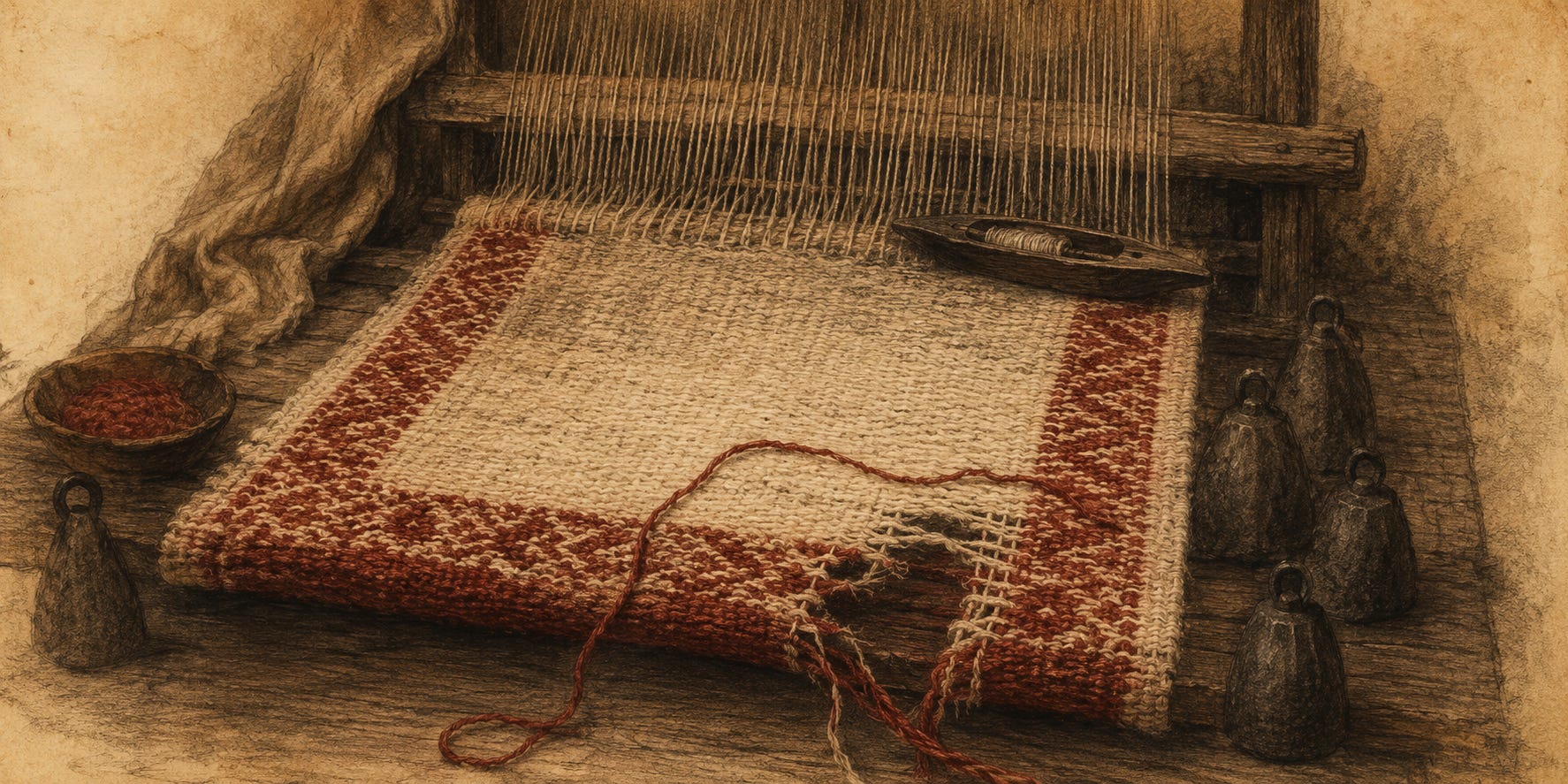
A companion essay on Arachne, Athena, weaving, pride, and the dangerous moment when mortal skill becomes too visible before divine power.
This is a companion essay to Arachne — The Weaver and the Goddess.
Arachne is often remembered as the girl who was punished for pride.
That is not wrong. The old stories are not gentle with mortals who speak too boldly before the gods. They know the danger of a raised voice in a world where heaven is near enough to hear it. But it is not enough. If Arachne were merely vain, her story would be smaller. It would warn us to lower our eyes, praise the divine, and keep human skill in its proper place.
The trouble is that Arachne can weave.
That is what gives the myth its pressure. Not arrogance alone. Not impiety alone. Skill. Real skill. Skill so exact that praise begins to gather around it, then comparison, then danger. The story does not begin with a liar claiming what she cannot do. It begins with a mortal girl whose hands make something undeniable.
And that is a more difficult matter.
In the ancient version made most famous by Ovid, Arachne is a girl from Lydia, the daughter of a dyer, whose weaving becomes so admired that people begin to compare her to Athena. The comparison matters because Athena is not merely a goddess who happens to favour beautiful work. She is the patroness of craft, intelligence, disciplined making, the clear mind that brings order into use. To weave under her name is to work beneath a divine law of pattern.
Arachne refuses the usual shelter of gratitude. She will not say that Athena taught her. She will not let her labour be turned into someone else’s blessing. Athena comes to her in the shape of an old woman and offers the warning that old women in myths so often carry: yield, give thanks, do not set a mortal mouth against the gods.
Arachne does not yield.
The contest begins.
It would be easier if Athena’s work were poor.
It is not.
Athena weaves the world as the gods understand it: ordered, splendid, enthroned. Her tapestry shows divine authority, cosmic arrangement, and the punishment of mortals who have challenged heaven and suffered for it. It is not false work. That is important. Athena is not a fraud frightened by a gifted girl. She is a goddess of craft. Her cloth carries grandeur because grandeur belongs to her.
Then Arachne weaves.
And what she weaves is not order from above, but injury seen from below. She shows the gods not as they wish to be praised, but as mortals have endured them. She shows divine desire entering human lives with terrifying ease. She shows women taken, deceived, overwhelmed, transformed, left with consequences they did not choose.
In that moment the contest is no longer merely between two makers. It becomes a contest between two visions of the world.
Athena’s cloth says: this is the order of things.
Arachne’s cloth says: this is what that order has cost.
That is why the myth cannot be reduced to a lesson against vanity. Arachne’s danger is not that she lies about the gods. It is that she refuses to flatter them.
The loom matters here. Weaving is not an incidental craft placed in the background because women needed something to do indoors. In the old stories, weaving is one of the ways human beings make sense of time. Thread becomes pattern. Separate strands become memory. What would otherwise remain scattered is gathered into form.
To weave is to make relation visible.
It is also to work in a medium of patience. A cloth cannot be made in one triumphant gesture. It requires repetition, correction, tension, and return. It remembers mistakes. It carries the pressure of the hands that made it. Arachne’s tapestry is therefore not only an accusation. It is labour given form.
That is part of its authority.
This is also why the punishment is so troubling.
Athena does not simply defeat Arachne. She does not merely say, “Your work is inferior.” She destroys the cloth. In many tellings, she strikes Arachne as well, and the girl is changed into the first spider, condemned to weave forever. The metamorphosis is often explained as fitting: the weaver becomes a creature of weaving.
But myth rarely becomes less disturbing when it becomes fitting.
Arachne is not turned into something unrelated to herself. She is not made into stone, or ash, or silence. Her punishment preserves the very gift that brought her into danger.
That is the terrible precision of it.
The old story seems to know that some punishments do not destroy what is best in a person. They isolate it. They strip away the human room around it. Arachne keeps the thread, but not the loom. She keeps the motion, but not the hands by which others once recognised her. She keeps the gift, but loses the world in which the gift could be praised, bought, argued over, envied, loved, misunderstood, and named.
She will weave.
There is mercy in that sentence, perhaps. But it is a dark mercy. It does not restore her. It does not answer her. It does not make the contest just. It leaves her with continuity after personhood has been wounded beyond repair.
This is why Athena must not be made small in the reading of the myth. If she becomes merely petty, the story loses its force. A petty goddess punishing a gifted mortal is only an injustice. A magnificent goddess punishing a gifted mortal is something more unsettling: a revelation about power, truth, and the limits of recognition.
The myth asks whether excellence can protect a mortal when excellence itself becomes the offence.
Arachne’s pride remains real. The story does not ask us to pretend otherwise. She speaks dangerously. She refuses reverence. She stands before a goddess with the confidence of someone who has mistaken accuracy for safety.
But the myth’s grief lies in the fact that her pride is attached to something true.
She is not empty. She is not pretending. Her hands know what they know.
That is why the story lasts.
A simpler tale would let us leave satisfied. The proud girl challenged the goddess; the goddess corrected her; the world returned to order. But Arachne leaves something behind that order cannot quite absorb. A thread remains loose. The cloth has been struck, but the image has been seen. The goddess may punish the maker, but she cannot make the question unmade.
Arachne’s myth is therefore not only a warning against pride. It is a warning about recognition: what power will praise, what power will claim, what power will tolerate, and what power will break when it sees itself rendered by mortal hands.
The spider in the corner is not a moral neatly completed.
It is a remnant.
A small, living sign that the story has not finished thinking about the girl at the loom.
She has been diminished, but not emptied. Changed, but not made meaningless. What remains of her is not triumph, and not consolation. It is continuance under judgement. The thread still descends. The web still gathers light. The old motion survives in a form no one can comfortably call justice.
The girl is changed.
The gift remains.
And somewhere in that unfinished mercy, the old story keeps weaving.