

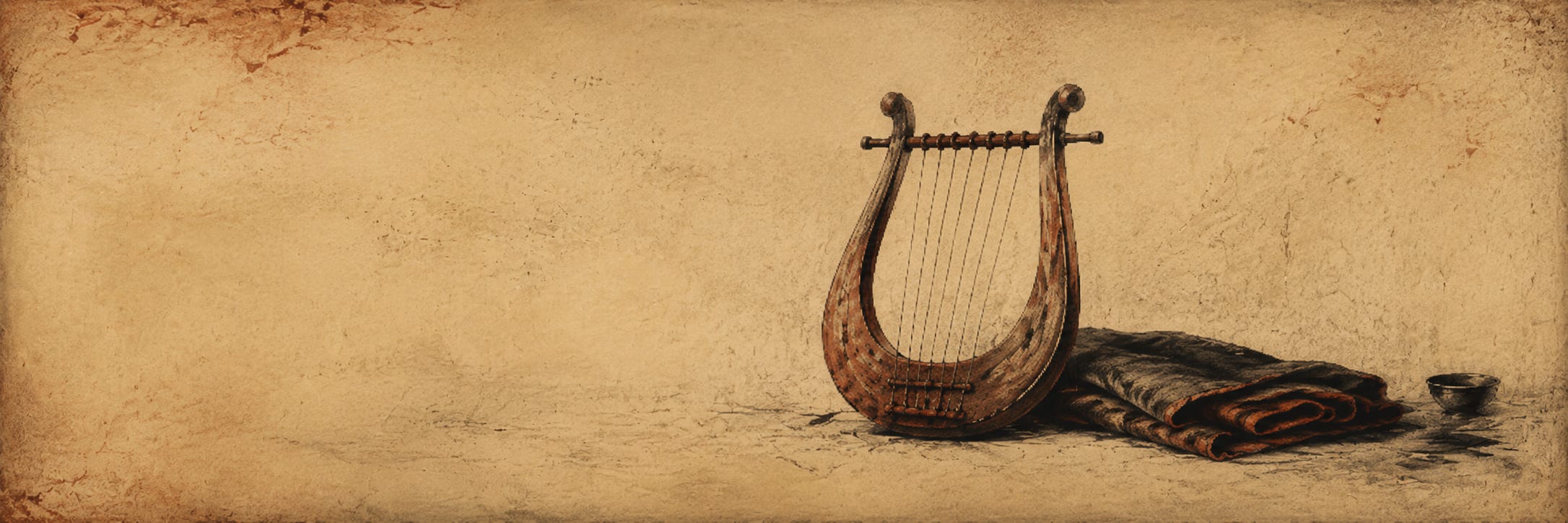
This is a reader’s guide to The Long Return VIII — The Songs of the Poet. Begin with the tale.
Before Odysseus gives his name, something else in the room gives him away.
Not an accusation. Not a question. Not a careless mistake.
A song.
This is how recognition begins before confession. Odysseus has come among the Phaeacians as a stranger. He has been washed, clothed, fed, honoured, and promised passage home. The house has received him properly. It has not demanded his history as the price of mercy. In this, Alcinous and Arete have done what a good house should do: they have delayed the question.
But delay is not the same as concealment forever.
Odysseus can withhold his name from his hosts. He can sit beside the king as a man rescued from the sea, not yet as the man who devised the fall of Troy. He can accept bread, wine, clothing, and honour under the shelter of anonymity. For a little while, he can be only “the stranger.”
Then Demodocus begins to sing.
And the hidden man hears himself approached by story.
The Phaeacians do not hear what Odysseus hears. This matters. To them, the songs of Troy belong to the great storehouse of heroic memory. The war has become shape, rhythm, public art. Names pass through the hall as famous names do: Achilles, Agamemnon, Odysseus, the ships, the quarrel, the horse, the city. The listeners can receive these things as song because distance has made them bearable.
No one in the room is being cruel. That is part of the scene’s discomfort.
The Phaeacians are not mocking the war. They are not trivialising grief on purpose. They are doing what distance allows human beings to do with the past: they have made it into something that can be sung indoors, after food, before guests, under lamplight.
But a story is never merely a story when the person it tells is sitting in the room.
For Odysseus, Troy has not yet become safely external. It has not settled into art. It has not become an object that can be admired from a courteous distance. It remains inside him: bodily, remembered, unfinished. The song does not teach him what happened. It returns him to what happened.
This is why the tears matter.
Odysseus does not stand and announce himself. He does not correct the song. He does not say, “I was there.” He does not take control of the room by turning listener into narrator. At first, he does the opposite. He hides.
The cloak rises.
That gesture is one of the great small gestures in the episode. It is dignity and concealment at once. It allows grief to happen without making it available for public handling. The face disappears, but the body has already spoken.
The mouth withholds the name. The body answers the song.
This is the first recognition. Not the formal recognition that will come later, not the scar, not the bed, not the reunion, not the named declaration of identity. It is recognition before speech, before proof, before social restoration. Something in the stranger’s body has answered to the story as only one who belongs to it could answer.
Alcinous sees this.
His first mercy is restraint. He notices the grief and does not immediately seize it. He does not make the wound explain itself. He turns the room away. He calls for the games. He gives the guest a way to recover his surface.
That is not avoidance yet. It is tact.
In The Odyssey, hospitality often depends upon timing. One must know when to ask and when not to ask. A stranger’s name matters, but not before he has been given food. A story matters, but not before the body has been received. Questions can be part of welcome, but asked too soon they become a form of possession.
Alcinous understands this. His greatness as host lies not only in generosity, but in sequence. First the bath. First the cloak. First the meal. First the promise of passage. The name can wait.
But the songs make waiting harder.
Demodocus is central here, though not because he personally understands what he has done. He is not interrogating Odysseus. He is not exposing him by design. He is not a detective of grief. He sings.
That is enough.
The strange power of Demodocus is that he recognises without knowing. He does not identify the stranger. He sings truly enough that the stranger identifies himself in silence.
To say only that poetry reveals truth would be too easy. The episode is sharper than that. Demodocus’s song enters a particular room at a particular moment, and in that room sits the one man for whom the song is not distant. The truth of the song is not abstract. It lands on the body that survived it.
The Phaeacians hear form.
Odysseus hears return.
That is why the second weeping is deeper. The first song opens the wound. The games allow pride, strength, and public composure to re-enter. The stranger is insulted, rises, throws beyond the others, and reveals another part of himself without naming it. The hall learns that he is not merely ruined. He is dangerous. He has weight, training, command, and memory in the limbs.
Then the song returns to Troy more directly, and this time Odysseus himself asks for it.
That choice matters.
The first wound comes upon him. The second he invites.
He honours Demodocus and asks him to sing of the wooden horse. This is not a man merely ambushed by memory. It is a man drawn toward the very story that hurts him, perhaps because he needs to hear whether it can be borne, perhaps because he wants to test the singer’s truth, perhaps because there are parts of the self that cannot remain hidden from the only voice in the room that seems to know them.
Then the song enters him again.
This is the terrible intimacy of the scene. Odysseus hears the plan sung beautifully. The cunning that saved the Greek cause and destroyed a city returns as music. The danger is not that the song is false. The danger is that it is true and beautiful.
Beauty does not soften the memory. It sharpens it.
Here the episode refuses easy comfort. Art does not simply heal. Story does not simply redeem. Song can honour what happened, but it can also make what happened newly unbearable. To hear one’s own past shaped by another voice is to lose control of it. The thing lived in terror, calculation, exhaustion, or necessity becomes something others can admire.
That is why the cloak rises again.
By now, Alcinous can no longer merely turn the room away. Earlier, silence was mercy. Now continued silence would be abandonment. A good host knows how to delay a question. A better host knows when delay has become refusal.
So he stops the song.
This is not intrusion. It is the next form of hospitality.
Alcinous has already given the stranger everything a good host should give before identity is known: water, clothing, food, honour, gifts, safe passage. But now the hidden grief has entered the hall twice. The house knows enough to know that not asking would be false. It would preserve the stranger’s privacy only by leaving him alone inside what the room has already seen.
The question must come.
“Tell us your name” is therefore not merely curiosity. It is not a demand for information. It is the moment when hospitality becomes recognition.
The Phaeacians cannot send him home unless they know where home is. They cannot honour him fully while pretending his tears have no meaning. They cannot keep treating him as only “the stranger” once the songs have shown that his history is larger than his silence.
This is why Book VIII matters so deeply before Book IX.
In Book IX, Odysseus will become the narrator of his own sufferings. He will begin the long account of the Cyclops, the winds, Circe, the dead, the Sirens, Scylla, Charybdis, and the losses that have carried him to this shore. But before he tells his story, he must first be brought to the point where telling is necessary.
The songs do not tell his story for him.
They make it impossible for him not to tell it.
That is the difference between recital and recognition. Demodocus sings of Troy as public memory. Odysseus hears it as private summons. Alcinous sees the summons taking hold and understands that the stranger can no longer remain only under the protection of anonymity.
Recognition begins before the name.
This pattern will return throughout The Odyssey. Odysseus will be known and not known, disguised and suspected, tested and doubted. His identity will emerge through speech, scars, dogs, servants, bows, beds, and the intelligence of those who know what cannot be faked. But here, among the Phaeacians, recognition begins in its most vulnerable form: not proof, not triumph, not reunion, but grief.
The great danger of this episode is not that Odysseus is exposed by accusation.
It is that he is exposed by accuracy.
No one tears the name from him. No one violates the guest-law. No one behaves shamefully. The song simply finds the place where the stranger is not a stranger to himself.
Before Odysseus speaks, the hall already knows this much: the war in the song has entered the man beside the king.
The cloak has risen.
The host has seen.
The lyre has stopped.
Recognition has begun.
Now the name must follow.